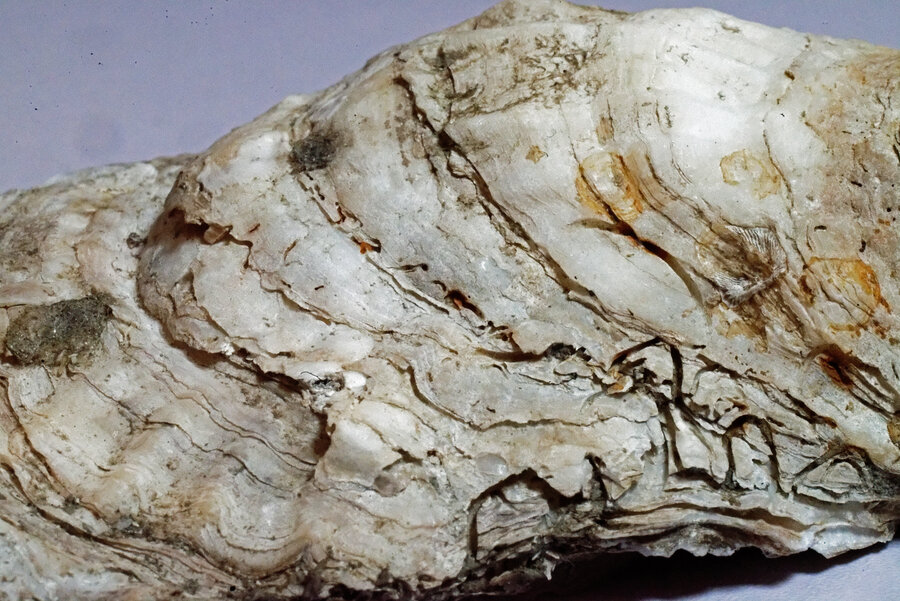

牡蛎
Mǔlì · 别名牡蛤、海蛎子壳
Muli · Oyster Shell
敛阴潜阳 · 软坚散结 Astringes Yin & Anchors Yang · Softens Hardness & Dissipates Nodules牡蛎壳自古被视为「介类」药材的代表,因其质地坚硬、层叠如山,古人取「以坚治坚、以涩敛散」之理,用于安神定惊、软坚散结。张仲景经方「柴胡加龙骨牡蛎汤」「桂枝加龙骨牡蛎汤」中,牡蛎常与龙骨相须为用,二者一为陆地古兽化石、一为海中贝类外壳,一刚一柔却同归「重镇安神」之效,体现了中医「同气相求」的配伍智慧。
Oyster shell has long been regarded as a representative shelled medicinal substance; its hard, layered texture led ancient physicians to apply the principle of "using hardness to treat hardness, using astringency to check dispersal," employing it to calm the spirit and soften hardened masses. In Zhang Zhongjing's classical formulas such as Chaihu Jia Longgu Muli Tang and Guizhi Jia Longgu Muli Tang, oyster shell is frequently paired with dragon bone—one a fossil of ancient land mammals, the other a marine shell—demonstrating the TCM compounding wisdom of "like activating like" in achieving the shared effect of calming and settling the spirit.
牡蛎主产于广东、福建、山东、辽宁等沿海地区,以近江牡蛎(Ostrea rivularis)及长牡蛎(Crassostrea gigas)的贝壳入药为主。《本草纲目》载:「牡蛎,言蛎最盛也,从蛎……在咸水中,附石而生,磈磈相连如房。」现代产区已形成规模化海洋养殖,采收后经去肉、清洗、晾晒、粉碎等工序制成药材。
Oyster shell is primarily produced along the coastal regions of Guangdong, Fujian, Shandong, and Liaoning, with the shells of the river oyster (Ostrea rivularis) and Pacific oyster (Crassostrea gigas) most commonly used medicinally. The Compendium of Materia Medica records: "The oyster is named for its abundance... it grows attached to rocks in salt water, clustered together like chambers." Modern production relies on large-scale marine aquaculture, with shells processed through flesh removal, cleaning, sun-drying, and crushing to produce the finished medicinal material.
牡蛎性味咸,微寒,归肝、肾经。功能敛阴潜阳、软坚散结、收敛固涩,主治阴虚阳亢所致的眩晕耳鸣、烦躁失眠,痰核瘰疬、癥瘕积聚,以及自汗盗汗、遗精滑精、崩漏带下等证。因其性偏寒凝收涩,凡实热积滞、外感未解者不宜单用。
Oyster shell is salty in flavor, slightly cold in nature, and enters the Liver and Kidney meridians. It astringes yin, anchors yang, softens hardened masses, dissipates nodules, and provides astringent consolidation. It is indicated for yin deficiency with yang hyperactivity manifesting as dizziness and tinnitus, restlessness and insomnia, phlegm nodules and scrofula, abdominal masses, as well as spontaneous or night sweating, seminal emission, and abnormal vaginal discharge or bleeding. Due to its cooling and astringent nature, it should not be used alone in cases of excess-heat stagnation or unresolved external contraction.
牡蛎入药需经「煅制」处理:将净牡蛎壳置于无烟炉火中煅烧至酥脆发白,取出研粉即为「煅牡蛎」,此法可增强其收敛固涩之效,多用于自汗盗汗、遗精滑精等证。若用于软坚散结,则多取生牡蛎直接捣碎入煎,以保留其原有清热软坚的特性,二者炮制方式不同,功效侧重亦有区别。
Oyster shell requires calcining before medicinal use: the cleaned shells are fired over a smokeless flame until crisp and whitened, then ground into powder to produce "calcined oyster shell," a process that enhances its astringent consolidating effect, commonly used for spontaneous sweating and seminal emission. When used to soften hardness and dissipate nodules, raw oyster shell is typically crushed directly for decoction to preserve its heat-clearing, hardness-softening properties—the two processing methods yield differing therapeutic emphases.
牡蛎性寒收涩,凡外感风寒未解、实热痰火壅盛者不宜单独使用,脾胃虚寒者亦应慎服。过量或长期服用可能影响钙质代谢,建议在中医师指导下确定剂量与疗程,不宜自行长期大量服用。
As oyster shell is cooling and astringent, it should not be used alone by those with unresolved external wind-cold contraction or excessive heat-phlegm-fire congestion, and those with spleen-stomach cold deficiency should also exercise caution. Excessive or prolonged use may affect calcium metabolism; dosage and duration should be determined under the guidance of a qualified TCM practitioner rather than self-administered long-term in large quantities.