党参
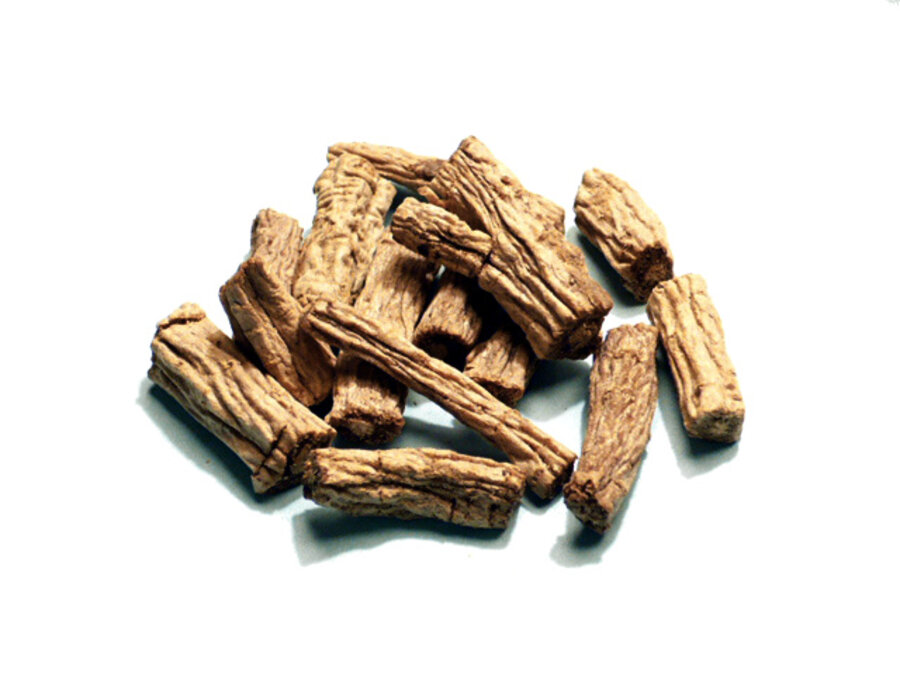
党参干燥根条标本
Dried Codonopsis root specimen
草部 · 平民人参 Plant Drug · The People's Ginseng党参因药性平和、补气效果与人参相近而价格远低于人参,历代民间常以其替代人参用于日常食补,故有"平民人参"之称。甘肃陇西素有"党参之乡"的美誉,当地至今仍保留着传统的种植与加工技艺,党参种植也成为不少山区农户脱贫增收的重要产业。
Because dangshen's nature is mild and its qi-tonifying effect resembles that of ginseng, yet at a far lower price, it has long been used by ordinary people as a household substitute for ginseng in daily dietary tonics, earning it the nickname "the people's ginseng." Longxi County in Gansu has long been known as the "hometown of dangshen," preserving traditional cultivation and processing techniques to this day, with dangshen farming becoming an important source of income for many mountain-region farming households.
党参之名源于古上党地区(今山西长治一带),因当地曾为主要产区而得名,现今主产区已转移至甘肃陇西、山西、陕西等黄土高原地带,其中甘肃陇西所产党参条粗、味甜、嚼之无渣,品质尤佳,为现代市场公认的道地药材。
The name "dangshen" derives from the ancient Shangdang region (present-day Changzhi, Shanxi), which was once its principal growing area. Today the main production has shifted to the loess plateau regions of Longxi (Gansu), Shanxi, and Shaanxi, with Longxi-grown dangshen — thick-rooted, sweet-tasting, and free of fibrous residue when chewed — recognized in the modern market as the premier-grade product.
党参味甘,性平,归脾、肺经,传统理论认为其能补中益气、健脾益肺、生津养血,适用于脾胃虚弱、气短乏力、食欲不振、久咳虚喘等证,因药性平和,也常作为食疗药膳的常见配料。
Dangshen is sweet in flavor and neutral in nature, associated with the Spleen and Lung meridians. Traditional theory credits it with tonifying the middle and boosting qi, strengthening the spleen and benefiting the lung, and generating fluids while nourishing blood — suitable for spleen-stomach weakness, shortness of breath with fatigue, poor appetite, and chronic cough with deficiency-type wheezing. Owing to its mild nature, it is also a common ingredient in medicinal food therapy.
党参采挖后经晒干或烘干制成生党参,切片入药,为最常用的炮制形式;亦有蜜炙党参的做法,以蜂蜜拌炒增强其补益之力,多用于气虚较甚、需长期调补的患者。
After harvesting, dangshen is sun-dried or oven-dried to produce raw dangshen, then sliced for use — the most common processed form. There is also a honey-fried preparation, stir-fried with honey to enhance its tonifying power, more often used for patients with more pronounced qi deficiency requiring long-term nourishment.
党参药性平和,但邪盛而正气未虚者不宜用,实证、热证及气滞胸闷者亦应慎用,以免助邪碍气;与人参同用时应注意剂量搭配,避免补益过度。
Although dangshen's nature is mild, it is unsuitable for conditions where pathogenic factors are strong but the body's own qi is not yet deficient; those with excess-type or heat-type conditions, or qi stagnation with chest oppression, should also use it with caution to avoid aggravating pathogens or obstructing qi flow. When combined with ginseng, dosage should be carefully balanced to avoid excessive tonification.