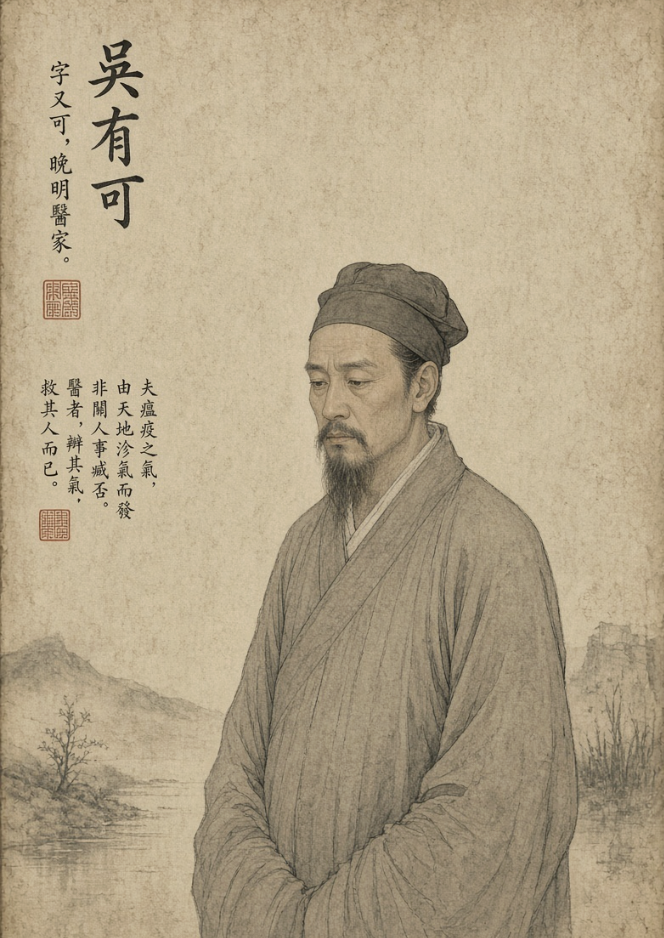
吴又可 Wu Youke
名有性,字又可
明末瘟疫大流行,吴又可亲历疫区诊治实践,观察到瘟疫的传播方式和致病规律与一般外感病不同,突破性地提出「戾气」学说,认为瘟疫是由一种「戾气」经口鼻侵入人体所致,而非传统的风寒暑湿等六淫之邪,这一见解已初具近代传染病病原学思想的雏形,比西方微生物致病理论早约200年。撰成《温疫论》,是中国温病学说发展的重要奠基之作。
Amid the devastating epidemics of the late Ming dynasty, Wu Youke treated patients directly in affected areas and observed that epidemic disease spread and behaved differently from ordinary externally-contracted illness. He broke with tradition to propose the "pestilential qi" theory: that epidemics were caused by a specific pathogenic factor entering the body through the mouth and nose, rather than by the conventional six climatic excesses. This insight anticipated, in embryonic form, the modern concept of a specific disease-causing pathogen — roughly two centuries before Western germ theory. His resulting Treatise on Epidemic Warm Diseases is a foundational text in the development of Warm Disease theory.