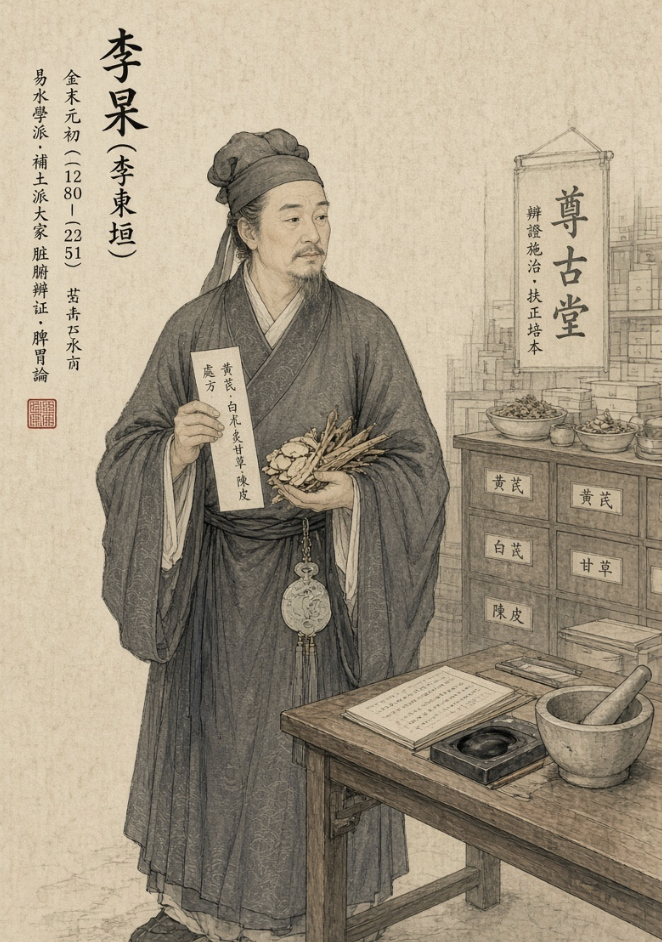
李杲 Li Gao
字明之 · 号东垣老人 · 世称李东垣
李杲学医的起点,是一段痛苦的记忆——他的母亲病重时,遍请庸医诊治却屡屡误治,最终不治而逝。这件事让他立志学医,后来他以千金作为拜师之礼,投入张元素门下,数年间尽得其传。他提出"内伤脾胃,百病由生"的核心观点,创制补中益气汤、甘温除热法,将"脾胃"确立为中医整体辨证的核心之一,后世将他列为金元四大家。他的著作《脾胃论》《内外伤辨惑论》流传于世,另有两部医籍是他去世后由弟子罗天益整理刊行。
Li Gao's path into medicine began with grief: his mother fell gravely ill and was mistreated by a succession of incompetent physicians before she died. This experience led him to devote himself to medicine. He paid a large sum in tuition to study under Zhang Yuansu and, within a few years, had mastered his teacher's methods in full. He proposed that "internal damage to the spleen and stomach gives rise to a hundred diseases," created the formula Buzhong Yiqi Tang and the "warming to clear heat" method, and established the spleen and stomach as a central pillar of Chinese medicine diagnosis — earning him a place among the Four Great Masters of the Jin-Yuan era. His works Spleen-Stomach Treatise and Distinguishing Internal and External Damage survive today; two further texts were compiled and published posthumously by his student Luo Tianyi.